

Original post by Stefano Beretta Professor at Politecnico di Milano – Visiting Professor at Auburn University, National Center for Additive Manufacturing Excellence (NCAME)
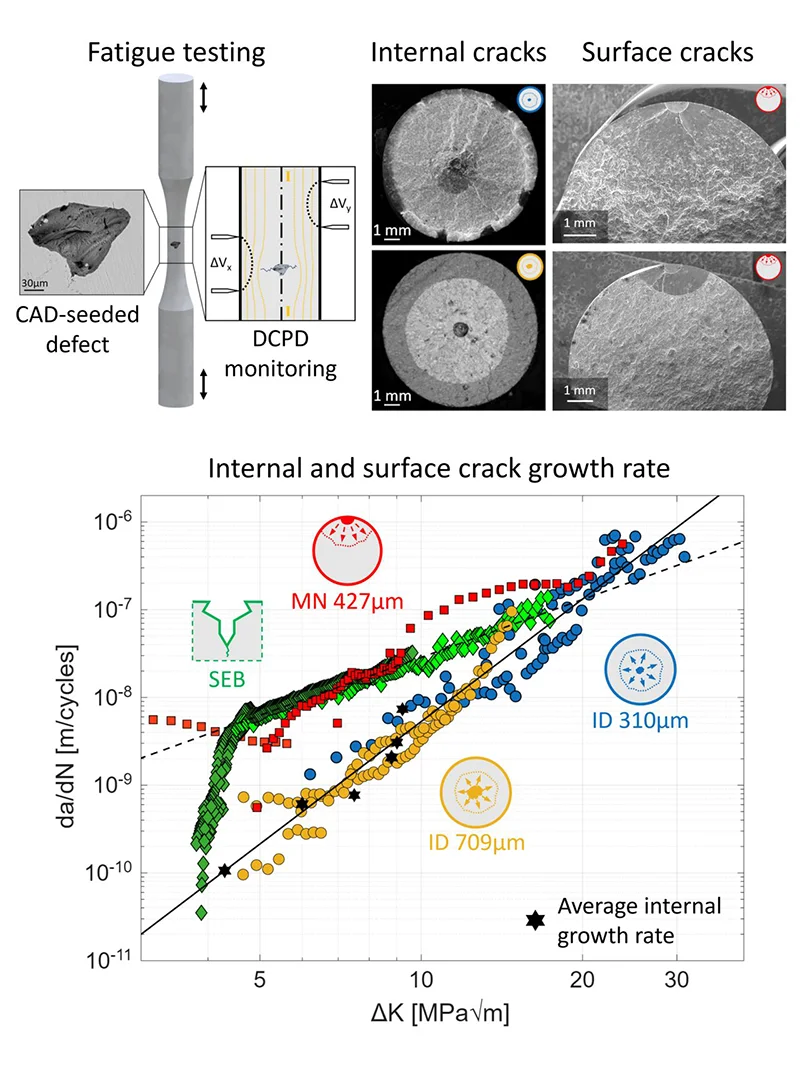
A very important result. Following analyses at National Center for Additive Manufacturing Excellence (NCAME) that showed a different growth rate for internal defects in Ti6Al4V (see: https://lnkd.in/e76QdAM2), we set-up at PoliMi a new procedure for measuring growth rate of internal cracks and we were able to show the same effect for Scalmalloy:
It is prospectively a dramatic change of scenario for the acceptance criteria for the internal flaws in hashtag#3Dprinted components.
Luca Mariotti, PhD candidate
I’m happy to share our new paper ✈️, focused on the application of DCPD as a reliable and accessible method for studying fatigue crack growth from internal cracks in additively manufactured Scalmalloy®.
In this work, we investigated the differences between internal and surface crack growth, showing that the atmospheric effect previously observed in Ti alloys also affects Scalmalloy®.
The work provides evidence that the difference in crack growth rate between internal and surface cracks is reflected in fatigue life. In some cases, this effect can be accounted for in life prediction models, potentially reducing conservatism by considering the lower impact of internal defects and making additive manufacturing more cost-effective.
The next step will be to increase throughput while maintaining Quality and, in doing so, further reduce the total cost of ownership of parts.
Then came the answer: an impressive display of AI-enabled manufacturing benefits presented by Ursa Major‘s Thomas Pomorski.
I’d label it: “Machine Learning means Learning Manufacturing”.
But Defense absorbing some of the most advanced Manufacturing Technologies may also be an indicator of a broader economic shift.
Just a few years ago, it would have been difficult to imagine Additive Manufacturing being discussed on the IMTS Main Stage with only one representative from the End-User side — and that End User being a Defense player.
Marie Niehaus-Langer, CEO of EOS, represented the excellence the AM process can offer. She made an interesting point: AM ultimately has to dissolve into the much larger ocean of Manufacturing.
It has to become a good neighbor to the other processes.
That reminded me of Art historian Aby Warburg’s famous Law of the Good Neighbor: the book you really need may not be the one you’re looking for, but the one sitting next to it on the shelf.
Maybe that is where Additive Manufacturing is today.
Not a manufacturing island anymore: just the very interesting neighbor you didn’t know you needed.
Last but not least: hybrid model goes too. See smart kid Jason Jones‘ Hybrid Manufacturing Technologies. CNC and AM inside the same machine. The neighbor who just moved in or ‘a low psychological barrier of entry in the Additive world’.
I hope that young Mechanical and Electronics Engineering students will feel excited to enter the job market in this moment of great acceleration.
#AdditiveManufacturing #AdvancedManufacturing #Defense #AerospaceIndustry