

A few reasons why, if you work in #Aeronautics, #SpaceIndustry or #Motorsports, you may want to pass this paper to your structural engineers.
A necessary disclaimer: I am not a specialist in this specific subject.
However, in a previous professional life I worked on fatigue resistance in Powder Metallurgy parts, adopting the Murakami methodology and, above all, the Miller approach.
With that background, I would highlight a few relevant advancements presented in this paper.
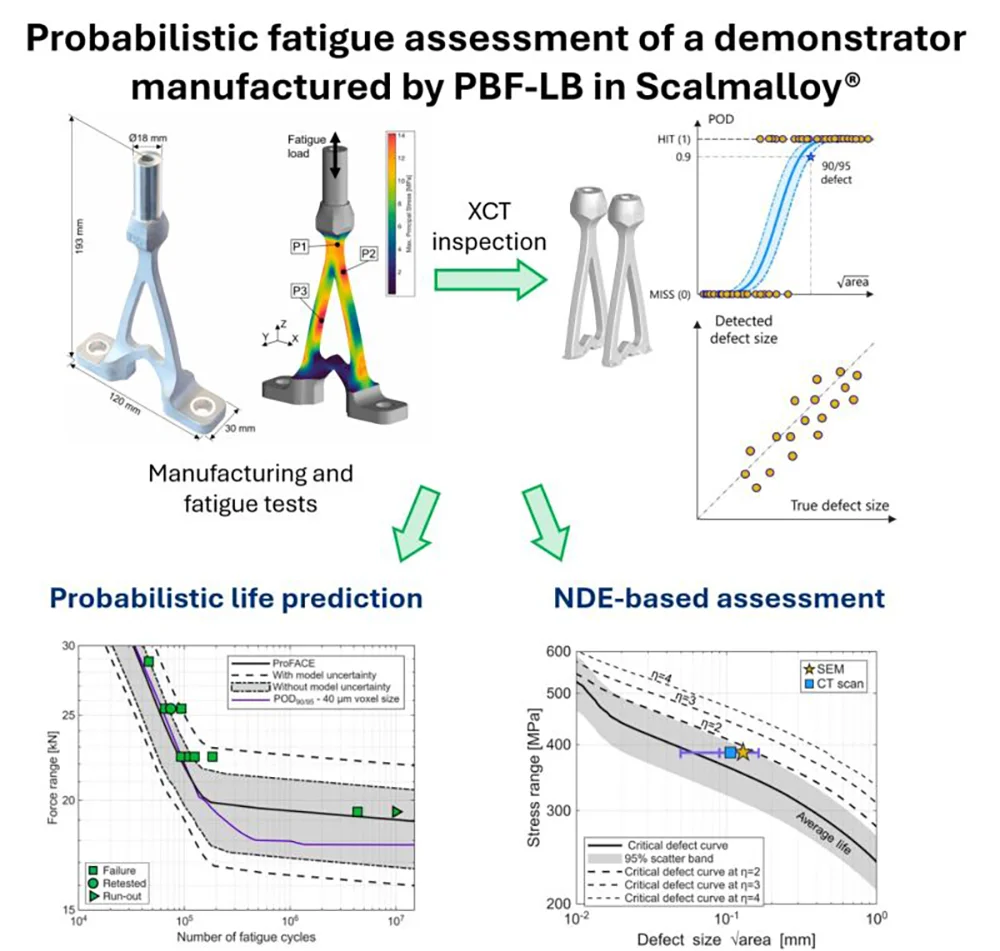
1.
From samples to parts.
Compared to the 2025 Perghem/Rusnati/Patriarca/Uriati/Beretta study, this paper takes an important step: it assesses fatigue crack growth in relation to the statistical population of defects not only on laboratory specimens, but on a real component.
2.
No fixed ranking of weak points.
Fatigue resistance is presented as a problem that must be assessed holistically. Not unlike Prof. Keith Miller’s approach, the component designer must evaluate the specific hierarchy of weak points in the stressed region of the component.
There is no fixed ranking of what leads to failure, whether local stress, residual stress, component geometry, defect population, lack of fusion, probability of finding a critical defect in the stressed volume, or something else.
There is a ranking for each case study. The hierarchy is not fixed.
One relevant implication: the focus should not be on average porosity alone, but on rare defects located in critical regions.
3.
From generic porosity metrics to defect criticality.
A shift in focus comes with moving from samples to real parts. Rather than seeking the best possible surface roughness and porosity throughout the entire component, the question becomes:
“Considering both detected and undetected defects, can this printed part be accepted for that application?”
More specifically:
“Given real defects, real component stresses, CT detection limits and fatigue-model uncertainty, can we quantify the fatigue risk?”
This is where the paper becomes especially relevant.
The deployment of Scalmalloy® printed parts in high-cycle fatigue applications would clearly benefit from predictive models.
But shouldn’t the same reasoning apply to any metal alloy used in Additive Manufacturing for fatigue-critical applications?
The case for using Additive Manufacturing in structural parts becomes more defensible when defect risk is quantified with sufficient confidence, including the probability of missed defects and the uncertainty of the fatigue model itself.
All in all, the team led by Prof. Stefano Beretta, a revered expert in fatigue studies, has published another relevant contribution to this field, particularly in the domain of Non-Destructive
Evaluation.
Structural engineers dealing with fatigue resistance of metal parts should follow the advancements carried forward by this team in the years to come.
Luigi Alzati
Politecnico di Milano Auburn University Mechanical Engineering #Fatigue #AluminumAlloys #AdditiveManufacturing
Original post by Professor Beretta:
Fatigue assessment of a demonstrator manufactured by PBF-LB
in Scalmalloy
The qualification of AM components requires robust fatigue assessment methods that can explicitly account for the impact of manufacturing-induced defects on fatigue life. Our latest work, conducted within the Smart-ProFACE project funded by the European Space Agency – ESA (partners: Thales Alenia Space, Leonardo, BEAMIT, MTC – Manufacturing Technology Centre), presents a probabilistic fatigue assessment of a demonstrator manufactured by PBF-LB in Scalmalloy. In this study, we carried out an extensive test campaign on Scalmalloy components, combining fatigue testing, X-ray micro-computed tomography, residual stress measurements, SEM fracture surface analysis and FE simulations. The study focuses on the uncertainty of the fatigue lifing model in probabilistic life prediction and XCT-based qualification.
Lorenzo Rusnati, Daniel Perghem, Stefano Miccoli, Vladimir Luzin, Sascha Senck, Stefano Beretta
You can read the full article here: https://lnkd.in/epWrJBJ5
#3dprinting, #fatigue, #Scalmalloy, #structuralintegrity, #XCT